open source · MIT · v1.7.5
A CMS that runs where your site does.
One config file in — database, REST + GraphQL APIs, and a full admin panel out. Built for SvelteKit and Cloudflare, and happy to sit on top of the database you already have.
$ npx highseam-init

highseam scaffolded.

  created:
      … 7 admin stubs
    + src/routes/admin/[collection]/[id]/+page.svelte
    + src/routes/admin/[collection]/[id]/versions/+server.ts
      … 22 more (admin + REST stubs)
    + src/routes/api/graphql/+server.ts
    + src/routes/media/[...key]/+server.ts
    + src/cms.config.ts
      … 4 more (hooks, theme, types, .dev.vars.example)
  wired:
    ~ vite.config.ts (added @tailwindcss/vite plugin)
    ~ src/routes/+layout.svelte (imported highseam.css)
    ~ .gitignore (added .data, .dev.vars*, !.dev.vars.example)

Next steps:
  1. REQUIRED — install Tailwind v4 (the admin needs it):
       npm i -D tailwindcss @tailwindcss/vite
  2. npm run dev → open /admin and create the first user (they become admin).
  3. Shape your content in src/cms.config.ts — collections there get a database,
     REST + GraphQL APIs, and admin UI automatically.
Real output, v1.7.5 on SvelteKit 2. The quickstart actually working is a feature.
One file in. Three out.
Declare a collection in cms.config.ts and it gets a database presence, REST + GraphQL APIs, and an admin UI, automatically. Point it at a table you already own and nothing migrates.
import { defineCollection } from 'highseam';

const venues = defineCollection({
  slug: 'venues',
  table: { name: 'venues', autoId: true },  // ← your existing table
  admin: {
    useAsTitle: 'name',
    groupsAs: 'tabs',
    filters: ['suburb', 'dog_friendly']
  },
  fields: [
    // names match your columns
    { name: 'name', type: 'text', required: true },
    { name: 'suburb', type: 'text' },
    { name: 'dog_friendly', type: 'checkbox' },  // 0/1 in SQL
    { name: 'rich_html', type: 'html' }  // sanitized on write
  ]
});name
dog_friendly
8,412 documents · page 1 of 421
SaveREST
GET /api/venues?where[suburb][equals]=brunswick&sort=-updated_atGraphQL
{ Venues { docs { name suburb dog_friendly } } }An 8,000-row table owned by your pipeline? It just got an admin, faceted search, and APIs. Nothing migrated.
Sits on your database
Your tables. Its admin.
Add table: to a collection and it maps onto an existing SQL table: one column per field, names matching your columns. A pipeline-fed table, a legacy schema, same admin, same APIs, same drafts as everything else.
Filters and sorts compile to plain SQL. Writes touch only the columns you declare; the rest of the table is none of the CMS’s business.
Table mode skips localized fields and upload collections, and drafts want a _status column. Document mode has no such limits.
How PawScapes edits 10,594 pipeline-built venues this way-- the admin's faceted filters become plain SQL
SELECT * FROM venues
WHERE suburb = ?1 AND dog_friendly = 1
ORDER BY name ASC LIMIT 20;
-- writes touch only the columns you declared
UPDATE venues SET name = ?1, rich_html = ?2 WHERE id = ?3;src/cms.config.ts your collections — the file you touch
src/lib/core/ framework-agnostic, no SvelteKit imports
crypto.ts Web Crypto only: PBKDF2 + HS256
adapters/memory.ts JSON file in dev
adapters/d1.ts Cloudflare D1 in productionwrangler d1 create highseam-db
npm run deploy # same core, now on WorkersRuns at the edge
No Node-only corners.
The core uses only Web Crypto: no bcrypt, no jsonwebtoken, no Node built-ins. The engine that runs in vite dev is the engine that runs on Cloudflare Workers, byte for byte.
Documents live in D1, files in R2, passwords as PBKDF2, sessions as HS256, all through the platform. Nothing is bolted on. Storage is an adapter: a fresh project starts on a JSON file you can read, then runs on D1 (local in dev, real in production) once the binding is set.
Media with a memory
Every image knows its own story.
Alt text, caption, credit and the focal point live on the image and are inherited everywhere it’s used; each use overrides only what it needs. Place the hotspot once and every crop follows: live aspect previews in the editor, mediaSrc() building Cloudflare Image Resizing URLs around it in production. Any image chip opens the full edit surface in a modal.
Imports are provenance-aware: batches keyed on external identity (never URL equality), files already sitting in your storage are adopted in place, and identical bytes dedupe by content hash. Every image shows where it’s used, with backlinks. The picker loads nothing until opened, so it doesn’t care whether you have forty images or forty thousand.
One original, every crop Adopting 7,954 photos without moving a byte
import { resolveMedia, mediaSrc, focalObjectPosition } from 'highseam';

// the image's own metadata is the default; each use overrides
// only what it needs — '' means "deliberately empty"
const img = resolveMedia(post.coverImage, { alt: post.coverAlt });

// Cloudflare Image Resizing URL, gravity from the stored focal point
const src = mediaSrc(post.coverImage, { width: 1200, aspect: '3:2' });<!-- no Image Resizing on the zone? mediaSrc returns the original
and object-position still steers the crop in the browser -->
<img {src} alt={img.alt} class="aspect-[3/2] object-cover"
style:object-position={focalObjectPosition(img.focalPoint)} />The editor
Write beside the real page.
Live preview is a pane next to the form, at whatever width you drag it to, or a 390px phone. Rich text goes full screen with the preview still alongside, and the preview follows every autosave without losing its scroll. Every save lists the fields it changed; compare any two versions word by word, and restore from the same panel.
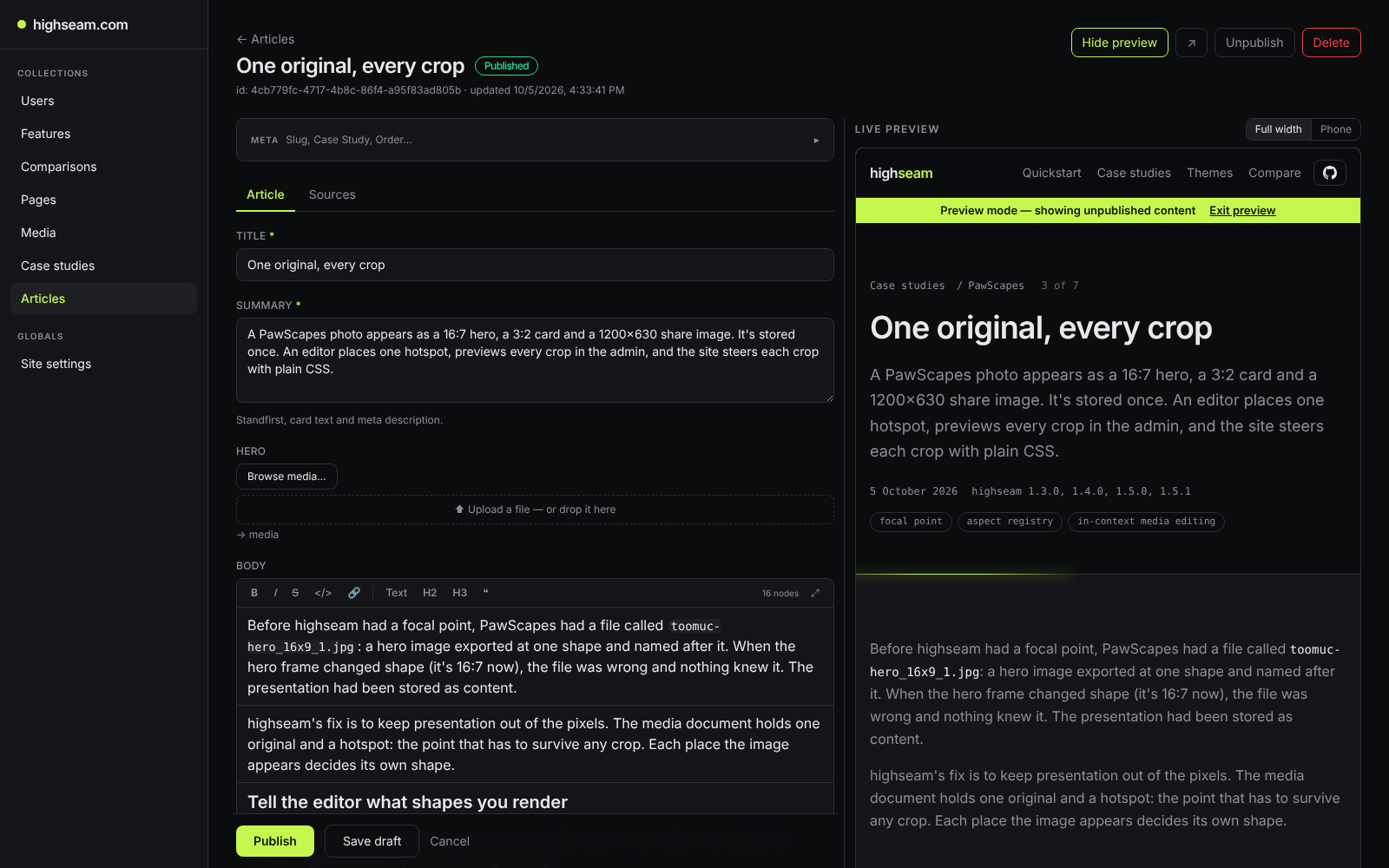
Blocks inside rich text
Galleries, embeds, FAQs, any typed block you define, dropped into the flow of a body. Type / to insert, drag to reorder.
Links stored by id
Pick a document or paste a URL. Internal links resolve at render, so renames never break them.
Repeaters and tags
Arrays edit as collapsible rows, string lists as chips. Nobody types JSON into a textarea.
Images edited in place
Any image chip opens its hotspot, crops and alt text in a modal, without leaving the page.
Case study
Proven on PawScapes.
Pepsi & Max's guide to dog-friendly Australia. A pipeline-built directory of more than ten thousand venues, edited in highseam without migrating a single row, and the production site most of highseam was proven on.
Read the case study- venues listed on the live site (5 Oct 2026)
- 10,594
- venues listed on the live site (5 Oct 2026)
- mirrored photos adopted as media docs, no bytes moved
- 7,954
- mirrored photos adopted as media docs, no bytes moved
- collections and globals in one config file
- 12 + 2
- collections and globals in one config file
- block types editors compose pages from
- 24
- block types editors compose pages from
And the parts you’d expect.
The long tail is where recreating a serious CMS architecture pays off.
Drafts & versions
Save draft, publish, unpublish, restore, plus scheduled publishing with no job runner.
Structured rich text
Typed nodes with embedded components, and sanitized HTML fields for pipeline-written content.
Live preview across two deploys
The admin mints short-lived signed tokens; your public site verifies and renders drafts.
See it in PawScapesAccess control
Booleans or query constraints, enforced identically in REST, GraphQL, and the admin.
Localization
Per-field locales with default-locale fallback; filters and unique checks are locale-aware.
Document locking
Five-minute rolling edit locks; a second editor sees who is already in the document.
API keys
Per-user keys authenticate any REST or GraphQL call.
Plugins
A plugin is a config transform, applied in order. No runtime magic to debug.
Generated TypeScript types
Selects become literal unions; blocks become discriminated unions on blockType.
Faceted filters & bulk actions
URL-synced facet controls; select rows, then publish, unpublish, or delete across the set.
See it in PawScapesGlobals & Local API
Singletons in the same config, and server-side CRUD that skips HTTP entirely.
Light / dark / system theming
A theme is a CSS token file. Copy it, change values. That’s the entire contract.
Galleries & embeds
Ordered image sets with per-use overrides, and click-to-load video embeds resolved server-side from a provider allowlist.
See it in PawScapesUpload dedupe
Identical bytes return the existing document (SHA-256 content hash) instead of a second copy. Opt out per collection.
See it in PawScapesDrift-checked upgrades
npx highseam-init --check-stubs diffs your route stubs against the installed templates. Your customisations are never flagged.
See it in PawScapesLinks stored by id
A link field holds a document reference or a URL. Internal links resolve at render, so renaming a page breaks nothing.
See it in PawScapesPreview pane & version compare
Live preview beside the form, full-screen editing, and word-level diffs between any two saves, with restore.
See it in PawScapesRepeaters, tags & slash insert
Arrays edit as collapsible rows, string lists as chips, and / in an empty paragraph inserts any block.
What it isn’t
- No collaborative cursors. One editor per document, enforced by rolling edit locks.
- No bundled image transform pipeline. highseam stores one original and never generates variants; the focal-point picker and mediaSrc() lean on Cloudflare Image Resizing on your zone.
- A young ecosystem. The plugin API is there; a marketplace isn’t.
- Two production deployments of note: a directory of more than 10,000 pipeline-built venues with a 7,954-photo media mirror, plus this site, which runs on it. Case studies.
Weighing alternatives? There’s an honest comparison table